
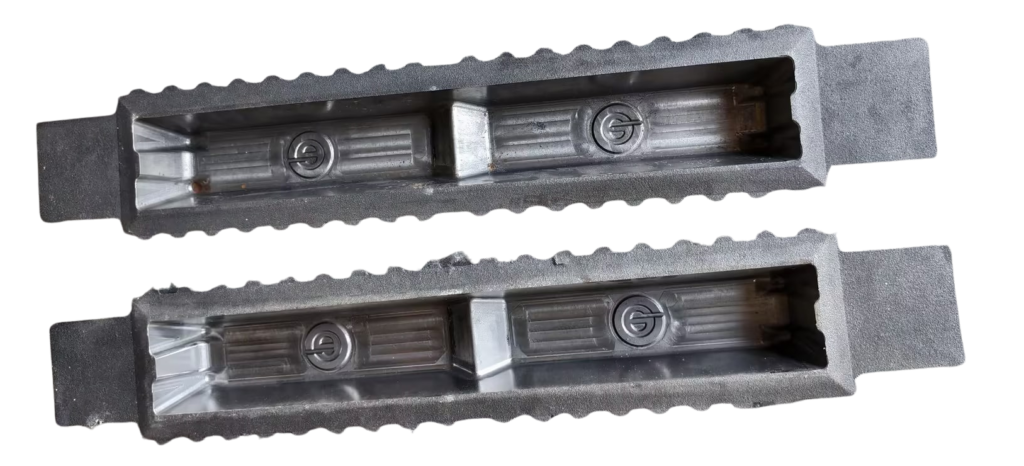
In aluminum ingot casting machines, cooling water tanks are crucial equipment for ensuring the quality of aluminum ingots. They allow hot molten aluminum to cool and solidify rapidly and evenly within the mold using water (or a waterless cooling method).
Material compare:
| Material type | Representative Number | advantage | shortcoming | Relative service life (reference) |
| gray cast iron | HT200, HT250 | It has good casting properties (good fluidity, high yield), the lowest production cost, moderate thermal conductivity, and a certain degree of self-lubrication, which facilitates demolding. | Poor thermal stabilityIt is prone to cracking under repeated rapid heating and cooling, resulting in a shorter lifespan. | Baseline (approximately 1-2 months) |
| Vermicular graphite cast iron | —— | Best overall performanceIt has a strength approximately 70% higher than gray iron, better thermal conductivity than ductile iron, and better resistance to thermal fatigue. | The production process control is more complex than that of gray iron. | It is gray iron.More than 2 times |
| Ductile iron | QT series | It has the highest tensile strength and toughness among the three materials. | It has the worst thermal conductivity and is prone to stress accumulation during thermal cycling, leading to cracking. | Approximately 120-150 days |
Key Processes and Design Considerations
To make aluminum ingot troughs more durable, the following points are typically considered during manufacturing and use:
Composition Control: For gray iron parts, controlling the carbon equivalent near the eutectic point (e.g., around 4.16%) and maintaining a pearlite matrix of over 98% helps improve thermal fatigue strength.
Draft Angle: The mold wall is usually designed with a 1°~3° draft angle to facilitate the aluminum ingot’s sliding down under its own weight after solidification, preventing damage to the mold from external impacts.
Surface Treatment: The inner wall needs to be smooth and is sprayed with a release agent (such as silicate-based coating) to prevent the molten aluminum from sticking together and causing difficulty in removing the ingot.
Manufacturing Method
Aluminum ingot troughs are typically produced using wet sand casting. This process is low-cost, highly adaptable, and very suitable for mass-produced cast iron parts like these.
As a consumable part, the production of aluminum ingot molds must ensure both the mold’s own strength and its resistance to thermal fatigue. In summary, the entire production process mainly includes three core stages: material selection, casting, and post-processing.
- Material Selection: Laying the Foundation for Performance
Aluminum ingot molds are repeatedly subjected to the scouring of molten aluminum (approximately 660-700℃) and rapid heating and cooling during operation; therefore, the choice of material directly determines its lifespan.
Mainstream Materials: Early materials often used gray cast iron (such as HT250), but its performance was generally average. Currently, vermicular graphite cast iron is the mainstream material, exhibiting excellent strength and resistance to thermal fatigue, with a service life more than twice that of gray cast iron and ductile iron.
Performance Optimization: By adding alloying elements such as chromium, molybdenum, and nickel, or by performing pre-furnace vermicularization treatment, the microstructure of the material can be further refined, improving fatigue strength.
- Casting: Constructing the Mold Body
This stage involves pouring molten metal into the mold blank.
Mainstream Process: The vast majority of aluminum ingot molds are produced using sand casting. This method offers high flexibility and low cost, making it suitable for manufacturing large castings with complex shapes.
Key Process Points: The crucial element is strict control of casting temperature and speed to prevent defects such as porosity and sand holes within the mold.
Advanced Design: In addition to traditional integral casting, split-type designs are now available. These separate the worn mold body from the support lugs, allowing for replacement of only the mold body after damage, significantly saving materials and repair time.
- Post-Processing: Enhancing Durability and Performance After the blank is produced, a series of processes are required to “strengthen” it.
Heat Treatment: Quenching and tempering eliminate casting stress and adjust the internal microstructure, thereby improving hardness and resistance to thermal fatigue, preventing mold deformation and cracking during use.
Precision Machining: Milling, drilling, and other machining processes are performed on the mounting contact surfaces to ensure accurate mold installation on the continuous casting machine.
Surface Protection: Nitriding or spraying the mold surface enhances wear resistance, reduces aluminum melt adhesion, and facilitates demolding of the formed aluminum ingot.
The current mainstream aluminum ingot mold production process involves selecting vermicular graphite cast iron material with high resistance to thermal fatigue, strictly controlling the casting process, and finally enhancing performance through heat treatment and surface treatment.