EN-GJS-400-15 represents one of the most versatile ductile iron materials specified across global engineering applications. Understanding EN-GJS-400-15 chemical composition, EN-GJS-400-15 mechanical properties, and EN-GJS-400-15 material equivalent grades enables engineers to optimize component design and achieve reliable manufacturing outcomes. This comprehensive guide explores the ductile iron EN-GJS-400-15 material specification, composition requirements, and practical applications that make it an economical choice for automotive components, machinery parts, and general engineering applications.
Industry professionals value EN-GJS-400-15 material for several compelling reasons:
- Minimum tensile strength of 400 MPa provides reliable load-bearing capacity for moderate to high-stress applications
- Elongation of 15% minimum delivers ductility preventing brittle failure in demanding service conditions
- Excellent machinability reduces manufacturing costs while enabling tight tolerance finishing operations
- Superior impact resistance compared to gray cast iron protects components in dynamic loading environments
- Cost-effective casting process minimizes material waste through near-net-shape manufacturing capabilities
- Good wear resistance extends component service life in friction and contact applications
- Proven reliability across diverse industries including automotive, construction equipment, and industrial machinery
Engineers who understand the EN-GJS-400-15 composition, EN-GJS-400-15 material properties, and EN-GJS-400-15 material equivalent grades can select appropriate specifications and achieve optimal performance with manufacturing economy.
Key Takeaways
- EN-GJS-400-15 delivers minimum 400 MPa tensile strength with 15% elongation suitable for high-load applications
- The EN-GJS-400-15 chemical composition includes controlled carbon, silicon, and nodularizing elements for spheroidal graphite formation
- International EN-GJS-400-15 material equivalent grades include QT400-15 (China), FCD400 (Japan), and ASTM A536 60-40-18 (USA)
- EN-GJS-400-15 mechanical properties include 250 MPa minimum yield strength with 130-180 HB hardness range
- The spheroidal graphite structure provides excellent ductility, impact resistance, and machinability advantages
- Applications include crankshafts, connecting rods, differential housings, pump bodies, valve components, and structural brackets
- Professional ductile iron casting foundries with ISO certification ensure consistent EN-GJS-400-15 material properties
- The EN-GJS-400-15 material specification follows EN 1563 standard requirements for production and testing
What Is EN-GJS-400-15 Material?
Material Classification
EN-GJS-400-15 follows the European standard designation system established by EN 1563 for ductile iron materials. The nomenclature breaks down into specific technical indicators defining material characteristics. “EN” signifies European Norm standardization, ensuring consistent EN-GJS-400-15 material specification across manufacturing regions. “GJS” identifies the material as ductile iron with spheroidal (nodular) graphite structure, distinguishing it from gray cast iron which uses “GJL” designation. The number “400” indicates minimum tensile strength of 400 megapascals measured on standard test bars, while “15” represents minimum elongation percentage.
This standardized designation system helps engineers and procurement specialists quickly identify EN-GJS-400-15 material properties without consulting detailed specification documents. The naming convention eliminates confusion when sourcing materials internationally. Manufacturers reference the same ductile iron EN-GJS-400-15 composition and performance characteristics regardless of geographic location or supplier.
The material also carries the numerical designation EN-GJS-400-15 with material number 5.3106 in European standards. These alternative designations appear on material certificates and technical documentation. Understanding multiple designation formats facilitates material verification during procurement and quality control processes.
Note: The spheroidal graphite structure distinguishes EN-GJS-400-15 from gray cast iron (EN-GJL series) where graphite appears in flake form. This microstructural difference fundamentally impacts EN-GJS-400-15 mechanical properties and application suitability, providing superior ductility and impact resistance.
Microstructure Characteristics
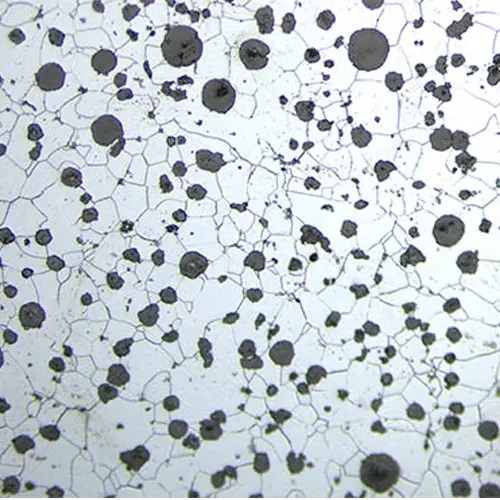
The distinctive performance characteristics of ductile iron EN-GJS-400-15 stem from its carefully developed microstructure during solidification. Molten iron containing the appropriate EN-GJS-400-15 chemical composition receives treatment with nodularizing elements (typically magnesium or cerium) that cause graphite to precipitate in spherical nodular form throughout the metallic matrix. These graphite nodules distribute uniformly, creating rounded inclusions rather than the sharp flakes found in gray cast iron.
The metallic matrix surrounding graphite nodules consists predominantly of ferrite in EN-GJS-400-15 material. Ferrite provides excellent ductility and toughness while maintaining good strength. This predominantly ferritic structure with spheroidal graphite delivers the balance of properties that makes EN-GJS-400-15 suitable for applications requiring both strength and ductility.
| Microstructure Component | Typical Content | Contribution to Properties |
|---|---|---|
| Spheroidal Graphite | 10-15% by volume | Ductility, machinability, stress distribution |
| Ferrite | >80% | High ductility, toughness, impact resistance |
| Pearlite | <20% | Strength contribution, limited in this grade |
| Carbides | Minimal/absent | Should be avoided for optimal properties |
The graphite nodules, unlike the flakes in gray iron, do not act as sharp stress concentrators. Their rounded shape allows the metallic matrix to deform around them under load, explaining the material’s excellent ductility and impact resistance. This characteristic enables EN-GJS-400-15 mechanical properties to approach cast steel performance while maintaining casting advantages.
The predominantly ferritic matrix delivers the high elongation values required by the EN 1563 specification. Ferrite’s face-centered cubic crystal structure allows extensive plastic deformation before fracture, providing the 15% minimum elongation that distinguishes this grade. This combination makes ductile iron EN-GJS-400-15 particularly valuable for applications requiring energy absorption and resistance to brittle failure.
Key Performance Attributes
EN-GJS-400-15 excels in applications where the combination of castability, machinability, and mechanical performance provides optimal value. The material demonstrates good wear resistance in moderate sliding contact applications, though not matching the performance of higher-strength ductile iron grades with more pearlitic matrices.
Impact resistance represents a distinctive advantage of ductile iron compared to gray cast iron. The EN-GJS-400-15 mechanical properties include impact energy absorption capacity significantly exceeding gray iron, typically 10-15 Joules in Charpy V-notch testing at room temperature. The spheroidal graphite morphology and ferritic matrix enable energy absorption through plastic deformation rather than immediate brittle fracture.
Machinability of ductile iron EN-GJS-400-15 exceeds steel while remaining somewhat below gray cast iron. The spheroidal graphite nodules break chips during cutting operations, though not as effectively as lamellar graphite flakes. Manufacturing operations achieve good productivity with carbide tooling and optimized cutting parameters. The moderate hardness range (130-180 HB) facilitates finishing operations to tight tolerances.
Ductility enables manufacturing processes including cold forming of minor features, straightening operations, and limited bending without cracking. This processing flexibility distinguishes EN-GJS-400-15 material from gray cast iron which cannot tolerate plastic deformation. However, extensive forming operations remain impractical compared to wrought steel materials.
Tip: When designing components requiring both casting complexity and impact resistance or ductility, prioritize EN-GJS-400-15 over gray cast iron to prevent brittle failure modes while maintaining manufacturing economy through casting processes.
EN-GJS-400-15 Chemical Composition
Understanding EN-GJS-400-15 chemical composition provides critical insight into material behavior during casting and service performance. The EN-GJS-400-15 composition includes carefully balanced elements that control graphite nodule formation, matrix structure, and EN-GJS-400-15 mechanical properties. Each element in the ductile iron EN-GJS-400-15 chemical composition serves specific purposes in achieving desired casting characteristics and performance outcomes.
Primary Alloying Elements
Carbon (C): 3.40% to 3.80%
Carbon content directly determines graphite quantity and potential for nodular graphite formation throughout the EN-GJS-400-15 material. The high carbon concentration enables excellent casting fluidity, allowing complex geometries to fill completely during pouring. During solidification, carbon precipitates as spheroidal graphite nodules when proper nodularizing treatment and cooling conditions exist.
The EN-GJS-400-15 chemical composition specifies carbon content in the hypereutectic range typical for ductile iron. This range balances casting fluidity, graphite nodule count, and final mechanical properties. Excessive carbon creates very soft material with reduced strength. Insufficient carbon results in carbide formation that reduces ductility and causes brittleness, compromising the fundamental advantages of ductile iron.
Foundries monitor carbon content during melting operations using spectrographic analysis. Carbon levels must be verified before nodularizing treatment of each production heat. The carbon equivalent (CE = %C + %Si/3 + %P/3) typically ranges from 4.3 to 4.6 for optimal EN-GJS-400-15 material properties and casting characteristics.
Silicon (Si): 2.20% to 2.80%
Silicon acts as a primary graphitizing element promoting graphite formation rather than carbide precipitation. The silicon range in EN-GJS-400-15 composition ensures adequate graphitization while controlling matrix structure. Silicon promotes ferrite formation in the matrix, contributing to the predominantly ferritic structure required for the high elongation specification of this grade.
Higher silicon content within the EN-GJS-400-15 chemical composition range increases ferrite percentage and reduces pearlite content. This effect produces the ductile, tough matrix characteristic of EN-GJS-400-15 mechanical properties. Silicon also improves casting fluidity and reduces shrinkage tendencies, enhancing casting soundness and reducing defect risk.
Silicon measurement requires accurate spectroscopic analysis during production. The combined effect of carbon and silicon determines graphite formation tendency and matrix microstructure. Modern foundries optimize silicon content based on component section thickness, cooling rate, and desired EN-GJS-400-15 material properties to ensure consistent results.
Magnesium (Mg): 0.03% to 0.06% (residual)
Magnesium represents the critical nodularizing element that distinguishes ductile iron from gray iron. Magnesium additions during the treatment process cause graphite to precipitate in spheroidal form rather than flakes. The residual magnesium in final EN-GJS-400-15 composition indicates successful nodularizing treatment.
Magnesium treatment typically adds 0.4-0.8% magnesium to molten iron, with most consumed by reactions with sulfur and oxygen. The remaining residual magnesium (0.03-0.06%) suffices for nodular graphite formation. Insufficient residual magnesium produces degenerate or flake graphite compromising EN-GJS-400-15 mechanical properties. Excessive magnesium creates carbides and surface defects.
The narrow acceptable residual magnesium range requires precise process control. Modern ductile iron foundries employ sophisticated treatment methods including ladle treatment, tundish treatment, or in-mold treatment. Each method delivers controlled magnesium additions ensuring consistent nodularization across production heats.
Manganese (Mn): 0.10% to 0.40%
Manganese in ductile iron EN-GJS-400-15 serves multiple functions including sulfur neutralization and minor matrix strengthening. However, EN-GJS-400-15 material specification limits manganese content to preserve the predominantly ferritic matrix essential for high elongation. Excessive manganese promotes pearlite formation, reducing ductility below specification requirements.
The relatively low manganese range in EN-GJS-400-15 chemical composition distinguishes this grade from higher-strength pearlitic ductile irons. Foundries carefully control manganese input through charge material selection. Low-manganese pig iron and selected steel scrap maintain manganese within target ranges.
Manganese also neutralizes sulfur by forming manganese sulfide inclusions. However, proper nodularizing treatment removes most sulfur, reducing manganese requirements for this purpose. The manganese specification primarily ensures sufficient ferrite formation for required EN-GJS-400-15 mechanical properties.
Impurity Element Control
Sulfur (S): Maximum 0.015%
Sulfur control represents critical importance in ductile iron production. Sulfur strongly inhibits nodularization by consuming magnesium through sulfide formation. The EN-GJS-400-15 composition requires very low sulfur content enabling effective nodularizing treatment with economical magnesium additions.
Raw material selection focuses heavily on sulfur content. Low-sulfur pig iron and carefully selected steel scrap minimize sulfur input. Modern foundries may employ desulfurization treatments before nodularizing, typically achieving 0.005-0.010% sulfur levels. These treatments react sulfur with calcium carbide, magnesium, or sodium-based desulfurizers.
Insufficient sulfur removal increases magnesium consumption during nodularizing treatment. The excess magnesium requirement raises costs and increases carbide formation risk. Proper sulfur control ensures consistent ductile iron EN-GJS-400-15 material properties with economical magnesium usage.
Phosphorus (P): Maximum 0.08%
Phosphorus creates brittleness in ductile iron by forming iron-iron phosphide eutectic that concentrates at cell boundaries. The phosphorus limit in EN-GJS-400-15 chemical composition prevents excessive steadite formation that would reduce ductility and impact resistance, compromising fundamental material advantages.
The EN-GJS-400-15 material specification maintains moderate phosphorus limits compared to gray iron. The spheroidal graphite structure provides some tolerance for phosphorus effects compared to flake graphite, but ductility requirements still necessitate control. Components subjected to impact loading or requiring maximum elongation should minimize phosphorus content.
Raw material selection controls phosphorus input since economical phosphorus removal from molten iron remains impractical. Pig iron typically contains higher phosphorus than steel scrap. Foundries blend charge materials achieving target phosphorus levels within EN-GJS-400-15 composition specifications while maintaining economical melting costs.
EN-GJS-400-15 Composition Comparison
Comparing ductile iron EN-GJS-400-15 chemical composition with adjacent grades clarifies the material’s position within the ductile iron family:
| Element | EN-GJS-400-15 | EN-GJS-450-10 | EN-GJS-500-7 |
|---|---|---|---|
| Carbon (%) | 3.40-3.80 | 3.30-3.80 | 3.20-3.80 |
| Silicon (%) | 2.20-2.80 | 2.20-3.00 | 2.20-3.00 |
| Manganese (%) | 0.10-0.40 | 0.20-0.80 | 0.20-0.80 |
| Magnesium (%) | 0.03-0.06 | 0.03-0.06 | 0.03-0.06 |
| Phosphorus (%) | Max 0.08 | Max 0.08 | Max 0.08 |
| Sulfur (%) | Max 0.015 | Max 0.015 | Max 0.015 |
Higher-strength grades allow increased manganese content promoting pearlite formation for enhanced strength at the expense of elongation. The EN-GJS-400-15 composition emphasizes ferrite formation through limited manganese, prioritizing ductility over maximum strength. This balance makes EN-GJS-400-15 suitable for applications requiring impact resistance and energy absorption.
Note: EN 1563 standard specifies that EN-GJS-400-15 chemical composition serves as production guidance. Final acceptance depends on meeting mechanical property requirements regardless of precise composition values within specified ranges. Foundries optimize composition for specific component geometries and cooling rates.
EN-GJS-400-15 Mechanical Properties
The performance characteristics defined by EN-GJS-400-15 mechanical properties determine material suitability for specific engineering applications. Comprehensive understanding of EN-GJS-400-15 material properties enables accurate stress analysis and appropriate safety factors during component design. The EN-GJS-400-15 material specification establishes minimum values ensuring reliable performance across diverse applications.
Tensile Properties
Tensile Strength (Rm): 400-600 MPa (minimum 400 MPa)
Tensile strength represents the primary acceptance criterion for EN-GJS-400-15 material specification. The minimum value of 400 MPa must be achieved when testing separately cast test bars. Typical production material often exceeds the minimum value, with 420-480 MPa common for well-controlled foundry processes producing predominantly ferritic structures.
The tensile strength of ductile iron depends primarily on matrix microstructure and graphite nodule characteristics. Ferritic matrices provide moderate strength with excellent ductility. Finer graphite nodule distribution and higher nodule count improve tensile properties by reducing stress concentrations. The EN-GJS-400-15 chemical composition and cooling rate during solidification control these microstructural features.
Testing procedures follow EN 1563 or ISO 1083 standards. Test specimens are machined from separately cast test bars to ensure consistent testing conditions. The test bar diameter and cooling rate approximate typical casting sections, providing representative EN-GJS-400-15 mechanical properties for design reference.
Yield Strength (Rp0.2): 250-370 MPa (minimum 250 MPa)
Yield strength indicates the stress level at which permanent plastic deformation begins. The EN-GJS-400-15 material specification requires minimum 250 MPa yield strength (0.2% offset method). This property helps engineers determine safe working stress levels and design appropriate safety factors.
The ferritic matrix characteristic of EN-GJS-400-15 composition produces relatively low yield strength compared to pearlitic ductile irons. However, the significant difference between yield strength and tensile strength indicates substantial work hardening capacity and good energy absorption capability. This property contributes to impact resistance and prevents sudden brittle failure.
Yield strength variations depend on matrix ferrite/pearlite ratio and grain size. Finer grain structures and higher ferrite content typically produce yield strengths near the specification minimum. Engineering calculations should use the minimum specified value (250 MPa) for conservative design unless specific production controls guarantee higher values.
Elongation (A): 15% minimum
Elongation represents a critical distinguishing characteristic of EN-GJS-400-15 mechanical properties compared to gray cast iron or higher-strength ductile iron grades. The minimum 15% elongation requirement ensures adequate ductility for dynamic loading, impact resistance, and safe failure behavior. This property prevents sudden brittle fracture, allowing components to deform visibly before failure.
The predominantly ferritic matrix achieved through EN-GJS-400-15 chemical composition control delivers the required elongation. Ferrite’s crystal structure permits extensive plastic deformation through dislocation movement. Spheroidal graphite nodules enable matrix deformation around nodules without initiating cracks, unlike flake graphite which creates stress concentration points.
Elongation values typically range from 15% to 25% depending on section thickness, cooling rate, and microstructure. Thicker sections cooling more slowly often achieve higher elongation through coarser ferrite grain structures. Engineers specify EN-GJS-400-15 when elongation exceeds 10% requirement, providing safety margin against brittle behavior.
| Property | EN-GJS-400-15 Value | Test Method |
|---|---|---|
| Tensile Strength (Rm) | ≥400 MPa (typical 420-480 MPa) | EN 1563, ISO 1083 |
| Yield Strength (Rp0.2) | ≥250 MPa (typical 250-320 MPa) | EN 1563, ISO 1083 |
| Elongation (A) | ≥15% (typical 15-25%) | EN 1563, ISO 1083 |
| Brinell Hardness (HB) | 130-180 HB | EN 1563 |
Hardness Characteristics
Brinell Hardness: 130-180 HB
Hardness measurements provide rapid, non-destructive verification of EN-GJS-400-15 material properties. The Brinell hardness range correlates with predominantly ferritic matrix microstructure. Lower hardness values indicate high ferrite content producing maximum ductility. Higher values suggest increased pearlite content or finer microstructure increasing strength while reducing elongation.
Foundries use hardness testing for production quality control. Measurements on production castings or test pieces verify that material meets expected values for the microstructure and ductile iron EN-GJS-400-15 mechanical properties. Hardness testing requires less time and specimen preparation than tensile testing, enabling economical verification.
The moderate hardness range provides acceptable wear resistance in light sliding contact applications while maintaining excellent machinability. Components operating in moderate friction environments benefit from hardness values toward the upper end of the specification range. However, applications requiring maximum impact resistance should target lower hardness values indicating high ferrite content.
Vickers Hardness: 140-210 HV (equivalent)
Vickers hardness measurements convert approximately to the Brinell hardness range. Vickers testing uses smaller indentation loads suitable for testing finished surfaces or small components where Brinell testing would damage parts. The hardness equivalence enables comparison between testing methods and verification on production components.
Physical Properties
Density: 7.05-7.15 g/cm³
The density of ductile iron EN-GJS-400-15 remains relatively constant regardless of composition variations within specification limits. This consistent density simplifies weight calculations during component design. The density approaches carbon steel (7.85 g/cm³) while remaining slightly lighter, providing modest weight savings for equivalent volumes.
Weight predictions use the standard density value (typically 7.1 g/cm³) multiplied by component volume. Accurate density enables precise calculation of component mass for shipping, handling, and dynamic load analysis. The graphite content slightly reduces density compared to steel by replacing denser iron with lighter carbon, though the effect remains small compared to aluminum alternatives.
Modulus of Elasticity: 169-175 GPa
The elastic modulus of EN-GJS-400-15 material properties approaches steel values more closely than gray cast iron. Typical values around 169-175 GPa represent material stiffness under tensile loading. The spheroidal graphite morphology provides more effective load transfer through the continuous metallic matrix compared to flake graphite interrupting matrix continuity.
Engineers must account for the slightly lower modulus compared to steel (200-210 GPa) when calculating deflection under load. Ductile iron components deflect somewhat more than equivalent steel parts carrying identical loads. However, the difference remains much smaller than gray cast iron (78-103 GPa), making EN-GJS-400-15 suitable for applications requiring good stiffness.
The modulus variation depends on graphite nodule distribution and matrix structure. Design calculations typically use conservative modulus values accounting for potential variation. The relatively consistent modulus across different casting sections makes ductile iron EN-GJS-400-15 more predictable than gray iron for stiffness-critical applications.
Poisson’s Ratio: 0.27-0.29
Poisson’s ratio for EN-GJS-400-15 material matches steel values closely (0.27-0.30). This property affects stress calculations in multiaxial loading conditions and influences lateral strain during tensile loading. The similarity to steel enables using standard calculation methods without special modifications for most applications.
Thermal Properties
Thermal Conductivity: 31-33 W/(m·K)
EN-GJS-400-15 material conducts heat less effectively than gray cast iron (46-50 W/(m·K)) but similarly to cast steel. The continuous metallic matrix provides the primary conduction path, with spheroidal graphite nodules acting as thermal insulators interrupting heat flow. This moderate conductivity suits applications without extreme thermal requirements.
Components requiring significant heat dissipation may favor gray cast iron over ductile iron. However, ductile iron EN-GJS-400-15 mechanical properties including impact resistance and ductility often outweigh thermal conductivity disadvantages for many applications. Heat transfer calculations should account for the moderate conductivity when thermal performance proves critical.
Coefficient of Thermal Expansion: 10.0-11.5 × 10⁻⁶/K
The thermal expansion coefficient of EN-GJS-400-15 mechanical properties matches carbon steel values closely. This compatibility minimizes thermal stress when assembling ductile iron components with steel parts. Similar expansion rates prevent loosening or binding across temperature variations, simplifying design of assemblies combining materials.
The spheroidal graphite nodules provide some dimensional stability by partially constraining matrix expansion. Ductile iron exhibits good dimensional stability under thermal cycling, though not matching gray iron performance in this regard. Precision applications should consider thermal expansion effects during temperature variations.
Specific Heat Capacity: 460-500 J/(kg·K)
Specific heat capacity indicates the energy required to change material temperature. EN-GJS-400-15 material absorbs heat moderately compared to other metals. This property influences thermal cycling behavior and cooling rate calculations during heat treatment or service conditions. The thermal mass affects component response to temperature changes in service.
Impact Properties
Charpy V-Notch Impact Energy: 10-20 Joules (room temperature, typical)
While EN 1563 standard does not specify mandatory impact testing for EN-GJS-400-15 at room temperature, impact resistance represents an important performance characteristic. Typical impact energy values range from 10-20 Joules in Charpy V-notch testing at room temperature, significantly exceeding gray cast iron (<3 Joules typically).
The ferritic matrix and spheroidal graphite morphology enable energy absorption through plastic deformation. Components subjected to impact loading or dynamic forces benefit from this characteristic. The impact resistance prevents brittle fracture that might occur with gray cast iron under similar loading conditions.
Low-temperature impact resistance decreases as temperature drops below 0°C, following typical ferritic material behavior. Applications requiring impact resistance at sub-zero temperatures should specify EN-GJS-400-15-LT (low temperature) or EN-GJS-400-15-RT (room temperature tested) variants with verified impact properties.
Tribological Characteristics
Wear Resistance
The ferritic matrix of EN-GJS-400-15 material provides moderate wear resistance in sliding contact applications. The material performs adequately in light to moderate friction environments, though higher-strength pearlitic ductile irons or gray cast iron offer superior wear resistance in severe conditions. The spheroidal graphite nodules provide some self-lubricating effect, though less pronounced than flake graphite.
Applications involving abrasive particles show acceptable wear resistance for moderate duty cycles. The EN-GJS-400-15 mechanical properties balance wear resistance with ductility and impact resistance. Service life often meets requirements for many industrial applications without surface hardening treatments. However, severe wear applications may justify surface hardening or alternative material selection.
Machinability
Ductile iron EN-GJS-400-15 demonstrates good machinability using carbide cutting tools and optimized parameters. The spheroidal graphite nodules break chips during cutting operations more effectively than steel, though not matching gray cast iron performance. Manufacturing operations achieve satisfactory productivity with appropriate tooling and cutting parameters.
Typical machining parameters for EN-GJS-400-15 material include:
- Cutting speeds: 120-180 m/min for turning and milling operations
- Feed rates: 0.1-0.3 mm/rev depending on operation type
- Depth of cut: 1-4 mm for roughing, 0.2-0.8 mm for finishing
- Tool materials: Carbide inserts recommended for production efficiency
The moderate hardness of EN-GJS-400-15 mechanical properties balances strength requirements with ease of finishing. Drilling, tapping, and threading operations proceed efficiently with proper tooling. Components can be machined to tight tolerances with good surface finish using conventional equipment.
Carbide tooling provides optimal tool life in production machining. Adequate coolant application helps evacuate chips and extend tool life. The overall machinability provides satisfactory manufacturing economy while delivering mechanical performance exceeding gray cast iron in ductility and impact resistance.
Tip: When selecting between ductile iron grades, consider that EN-GJS-400-15 mechanical properties prioritize ductility and impact resistance over maximum strength. Applications requiring energy absorption, dynamic loading resistance, or safety against brittle failure benefit from this grade compared to higher-strength but less ductile alternatives.
EN-GJS-400-15 Material Specification Standards
Multiple international standards govern production and testing of ductile iron, ensuring consistency across manufacturing regions. Understanding applicable EN-GJS-400-15 material specification standards facilitates international sourcing and quality verification. These standards define requirements for chemical composition, mechanical properties, testing methods, and certification.
European Standards
EN 1563:2018 (Current Standard)
The European standard EN 1563 titled “Founding – Spheroidal Graphite Cast Irons” provides comprehensive specifications for ductile iron production and testing. This standard replaced earlier national standards including DIN 1693 (Germany), BS 2789 (United Kingdom), and NF A32-201 (France). The EN-GJS-400-15 material specification follows requirements established in EN 1563:2018.
EN 1563 covers:
- Material designation system and grade classifications
- EN-GJS-400-15 chemical composition guidance ranges
- Mechanical property requirements including test methods
- Test bar casting procedures and dimensions
- Nodule structure evaluation methods
- Inspection and certification requirements
- Acceptance criteria and dispute resolution procedures
The standard specifies minimum tensile strength, yield strength, and elongation values for various ductile iron grades determined from separately cast test bars. The EN-GJS-400-15 material properties must meet minimum 400 MPa tensile strength, 250 MPa yield strength, and 15% elongation measured on appropriate test bars. Hardness ranges provide additional verification of microstructure.
EN-GJS-400-15 Numerical Designation
The European numerical designation system assigns material number 5.3106 to EN-GJS-400-15 material. This numerical format appears on some material certificates and technical documentation. The designation system provides alternative identification enabling cross-referencing in material databases and procurement systems.
International Standards
ISO 1083:2004 – Spheroidal Graphite Cast Irons Classification
The International Organization for Standardization publishes ISO 1083 covering ductile iron classification and properties. This global standard harmonizes with regional standards including EN 1563. The ISO designation for equivalent material uses “ISO 400-15” or simply “400-15” indicating minimum tensile strength and elongation percentage.
ISO 1083 establishes:
- Material property requirements aligned with EN 1563
- Test methods and specimen preparation procedures
- Designation system conventions for international use
- Nodule evaluation criteria and acceptance limits
- International grade equivalencies facilitating trade
Manufacturing facilities producing for international markets typically reference both EN 1563 and ISO 1083 specifications. The standards align closely, with minor differences in documentation formats. Material produced to EN 1563 specifications generally satisfies ISO 1083 requirements, enabling acceptance across multiple markets.
Former National Standards
DIN 1693 (Germany) – GGG40
Before European standard harmonization, German foundries produced this material according to DIN 1693 with designation GGG40. The “GGG” abbreviation stands for “Gusseisen mit Kugelgraphit” (cast iron with spheroidal graphite), while “40” indicates minimum tensile strength in kgf/mm² (approximately 400 MPa). Many historical German engineering drawings specify GGG40.
The EN-GJS-400-15 material specification replaced DIN 1693 GGG40 with equivalent properties and applications. Legacy documentation may reference the older designation. Material certificates from German foundries often include both designations facilitating international recognition and ensuring continuity for existing component specifications.
BS 2789 (United Kingdom) – Grade 400/12
British Standard BS 2789 classified similar material as Grade 400/12 before adopting European standards. The designation indicated minimum tensile strength of 400 MPa with 12% elongation, slightly lower ductility than current EN-GJS-400-15 specification. UK foundries now primarily reference EN 1563, though older specifications may cite BS 2789 requiring careful verification of property requirements.
NF A32-201 (France) – FGS400-15
French standard NF A32-201 designated this material as FGS400-15 where “FGS” represents “Fonte à Graphite Sphéroïdal” (spheroidal graphite cast iron), with numbers indicating tensile strength and elongation. The French standard aligned closely with European specifications, easing the transition to EN 1563 harmonization.
Specification Requirements
Mechanical Property Testing
The EN-GJS-400-15 material specification requires tensile testing of separately cast test bars to verify mechanical properties. Standard test bars typically measure 25mm or 30mm diameter depending on component section thickness, with smaller diameter test bars (12-20mm) specified for thin-section components. Test specimens are machined to specified gauge dimensions before testing according to standard procedures.
Testing frequency depends on production volume and customer requirements:
- Per-heat testing for critical applications requiring complete traceability
- Periodic sampling for established production demonstrating process capability
- First article inspection for new component qualifications
- Special testing programs for safety-critical applications
- Continuous monitoring through statistical process control
Hardness testing provides supplementary verification without destructive testing requirements. Brinell hardness measurements on production castings or test pieces confirm expected microstructure correlating with tensile properties.
Metallographic Examination
Microstructure evaluation verifies graphite morphology and matrix structure meet EN-GJS-400-15 material specification requirements. Polished and etched samples examined under microscope confirm:
- Spheroidal graphite nodule morphology (nodularity >80% typically required)
- Predominantly ferritic matrix structure (>80% ferrite typical for this grade)
- Absence of excessive carbides, inclusions, or porosity
- Appropriate nodule count and distribution ensuring uniform properties
Metallographic examination typically occurs during process qualification, new component approval, and periodic verification. Critical applications may require per-lot microstructure confirmation. Digital image analysis systems provide objective quantification of nodularity percentage, nodule count per unit area, and matrix constituent percentages.
Documentation and Certification
Foundries supply material certificates documenting compliance with EN-GJS-400-15 material specification requirements. Typical certificates include:
- Chemical composition analysis results for major and residual elements
- Mechanical property test data (tensile strength, yield strength, elongation)
- Hardness measurements from test pieces or production castings
- Metallographic examination results (nodularity, matrix structure)
- Heat identification and complete traceability information
- Compliance statement with applicable standards (EN 1563, ISO 1083)
Inspection certificates following EN 10204 Type 3.1 or 3.2 formats provide comprehensive quality documentation. Type 3.1 certificates include independent verification by authorized inspection personnel. Type 3.2 certificates include verification by independent inspection agencies or customer representatives. These certificates enable customer verification of material properties and regulatory compliance.
Tip: When procuring EN-GJS-400-15 material, specify the required certification level (EN 10204 3.1, 3.2, etc.) and any special testing requirements during initial quotation stages to avoid delivery delays or documentation misunderstandings.
EN-GJS-400-15 Material Equivalent Grades
Engineers frequently need to identify EN-GJS-400-15 material equivalent grades across international standards for global sourcing and material substitution. Understanding equivalent designations ensures material compatibility when specifications reference different standards. The EN-GJS-400-15 material equivalent system facilitates international trade and technical communication across borders.
Chinese Standard Equivalent
QT400-15 (GB/T 1348)
The Chinese national standard GB/T 1348 designates equivalent ductile iron as QT400-15. The “QT” abbreviation represents “Qiu Tie” (spheroidal graphite iron in Chinese), while “400” indicates minimum tensile strength in MPa and “15” represents minimum elongation percentage. Chinese foundries produce QT400-15 extensively for automotive components, machinery castings, and construction equipment applications.
The QT400-15 chemical composition and mechanical properties align closely with EN-GJS-400-15 material specification:
- Tensile strength minimum: 400 MPa
- Yield strength minimum: 250 MPa
- Elongation minimum: 15%
- Brinell hardness: 130-180 HB
- Predominantly ferritic matrix microstructure
Chinese automotive manufacturers, machinery producers, and construction equipment industries commonly specify QT400-15. The widespread availability and established production processes make this EN-GJS-400-15 material equivalent readily available from Chinese foundries. Material certificates reference both GB/T 1348 and international equivalent designations enabling global supply chain integration.
Engineers substituting between EN-GJS-400-15 and QT400-15 should verify that both chemical composition and mechanical properties satisfy application requirements. The materials perform equivalently in most general engineering applications requiring moderate strength with good ductility and impact resistance.
Japanese Standard Equivalent
FCD400 (JIS G 5502)
Japanese Industrial Standard JIS G 5502 classifies equivalent ductile iron as FCD400. The “FCD” designation abbreviates “Ferrous Cast Ductile” or “Ferrite Cast Ductile” in some contexts, while “400” indicates minimum tensile strength in MPa. Japanese automotive industry and machinery manufacturers utilize FCD400 extensively for engine components, suspension parts, transmission housings, and structural components.
FCD400 specifications include:
- Tensile strength minimum: 400 MPa (41 kgf/mm²)
- Yield strength minimum: 250 MPa (26 kgf/mm²)
- Elongation minimum: 15%
- Hardness range: 140-190 HB
- Predominantly ferritic matrix microstructure
The Japanese standard includes rigorous testing requirements and quality control procedures consistent with automotive industry demands. Test bar dimensions and testing procedures follow JIS G 5502 methods. However, mechanical property targets align with ductile iron EN-GJS-400-15 material equivalent performance characteristics.
Japanese foundries maintain rigorous quality control systems supporting automotive and precision machinery industries. FCD400 castings demonstrate consistent properties and excellent surface quality. This EN-GJS-400-15 material equivalent provides reliable performance in demanding applications requiring impact resistance and ductility.
American Standard Equivalent
ASTM A536 Grade 60-40-18
The American Society for Testing and Materials specifies ductile iron in ASTM A536 standard. Grade 60-40-18 designation indicates minimum tensile strength of 60,000 psi (414 MPa), minimum yield strength of 40,000 psi (276 MPa), and minimum elongation of 18%. This grade provides the closest American equivalent to EN-GJS-400-15 material specification.
ASTM A536 Grade 60-40-18 characteristics:
- Tensile strength minimum: 60 ksi (414 MPa)
- Yield strength minimum: 40 ksi (276 MPa)
- Elongation minimum: 18% (in 2 inch gauge length)
- Hardness typically: 140-190 HB
- Predominantly ferritic matrix structure
The ASTM system emphasizes mechanical property requirements with less emphasis on chemical composition control compared to European standards. Foundries optimize composition to achieve required strength, ductility, and casting quality. This approach provides manufacturing flexibility while ensuring performance consistency.
The slightly higher strength and elongation requirements of Grade 60-40-18 compared to EN-GJS-400-15 result from different test specimen geometries and gauge lengths. When properly adjusted for testing methodology differences, the materials provide equivalent application performance.
ASTM A395 Grade 60-40-18
ASTM A395 specifies ferritic ductile iron specifically for pressure-containing applications including valve bodies, pump housings, and piping components. Grade 60-40-18 indicates the same mechanical property requirements as ASTM A536 Grade 60-40-18. The standard includes additional requirements for pressure tightness and defect acceptance criteria.
Components handling pressurized fluids commonly reference ASTM A395 specifications. The EN-GJS-400-15 material equivalent provides adequate strength for moderate pressure applications when designed with appropriate safety factors and quality controls.
Other International Equivalents
Italy: GS400-15 (UNI Standards)
Italian standard UNI designates this material as GS400-15, following similar nomenclature conventions. The “GS” indicates spheroidal graphite cast iron (Ghisa Sferoidale), with numbers representing tensile strength and elongation. Italian foundries supply GS400-15 castings for domestic machinery, automotive, and industrial applications.
France: FGS400-15 (NF Standards)
French standards historically designated this material as FGS400-15 before adopting European harmonized standards. The designation “FGS” represents “Fonte à Graphite Sphéroïdal” (spheroidal graphite cast iron). French foundries now primarily reference EN 1563 but may include FGS400-15 designation on legacy drawings and technical documentation.
Russia: VCh40 (GOST 7293)
Russian standard GOST 7293 classifies this material as VCh40 where “VCh” represents ductile iron and “40” indicates strength classification (kgf/mm²). Russian manufacturing facilities produce VCh40 for domestic machinery, automotive, and infrastructure applications. The mechanical properties align with EN-GJS-400-15 material equivalent specifications.
Australia: AS 1831 Grade 400/15
Australian standard AS 1831 designates equivalent material as Grade 400/15. The designation directly indicates tensile strength and elongation requirements. Australian foundries supply ductile iron castings for mining equipment, agricultural machinery, and industrial applications requiring moderate-strength castings with good ductility.
Equivalent Grade Comparison Table
| Standard | Designation | Tensile Strength | Yield Strength | Elongation | Primary Region |
|---|---|---|---|---|---|
| European (EN 1563) | EN-GJS-400-15 | ≥400 MPa | ≥250 MPa | ≥15% | Europe |
| ISO 1083 | ISO 400-15 | ≥400 MPa | ≥250 MPa | ≥15% | International |
| China (GB/T 1348) | QT400-15 | ≥400 MPa | ≥250 MPa | ≥15% | China |
| Japan (JIS G 5502) | FCD400 | ≥400 MPa | ≥250 MPa | ≥15% | Japan |
| USA (ASTM A536) | 60-40-18 | ≥414 MPa (60 ksi) | ≥276 MPa (40 ksi) | ≥18% | North America |
| Germany (Former DIN 1693) | GGG40 | ≥400 MPa | ≥250 MPa | ≥15% | Germany (legacy) |
| UK (Former BS 2789) | 400/12 | ≥400 MPa | ≥250 MPa | ≥12% | UK (legacy) |
| Russia (GOST 7293) | VCh40 | ≥400 MPa | ≥250 MPa | ≥15% | Russia/CIS |
| Australia (AS 1831) | 400/15 | ≥400 MPa | ≥250 MPa | ≥15% | Australia |
Material Substitution Considerations
When substituting between EN-GJS-400-15 material equivalent grades from different standards, engineers should verify several critical factors:
Mechanical Property Alignment
Compare minimum tensile strength, yield strength, and elongation requirements across standards. Most EN-GJS-400-15 material equivalent grades specify 400 MPa minimum tensile strength providing similar load-bearing capacity. Verify that all mechanical property requirements meet application needs including hardness ranges and any impact requirements.
Testing methods may differ slightly between standards. ASTM uses 2-inch gauge length for elongation measurement while European/ISO standards typically use proportional gauge lengths. These testing variations affect reported elongation values though actual material ductility remains equivalent. Engineers should understand testing method differences when comparing specifications.
Chemical Composition Variations
Different standards may specify varying EN-GJS-400-15 composition ranges. Chinese QT400-15 and Japanese FCD400 allow slightly different silicon and manganese ranges compared to European specifications. American ASTM standards emphasize mechanical properties over composition control, providing foundries flexibility in composition optimization.
Foundries adjust composition within local standard requirements to achieve target mechanical properties and casting characteristics. The composition variations between equivalent grades rarely affect application performance when mechanical property requirements are satisfied. However, specialized applications requiring specific composition limits should explicitly specify those requirements.
Section Size Effects
All ductile iron standards recognize that mechanical properties vary with casting section thickness. Thicker sections cool more slowly, producing coarser microstructures with somewhat different properties. EN-GJS-400-15 material specification bases properties on test bars representing typical medium-section castings (approximately 25-30mm diameter).
When substituting materials, verify that section thickness considerations align across standards. Some standards provide property adjustments or specify different test bar sizes for different section thicknesses. Component design should account for actual section thickness effects on EN-GJS-400-15 mechanical properties.
Heat Treatment and Surface Treatment Compatibility
Verify that any heat treatment or surface treatment specifications remain appropriate when substituting between EN-GJS-400-15 material equivalent grades. Ductile iron response to thermal treatments generally remains consistent across equivalent materials. Surface treatments including painting, plating, or coating systems developed for one standard typically work satisfactorily with equivalent materials.
The similar ferritic matrix microstructure and spheroidal graphite morphology ensure compatible heat treatment responses. Surface preparation requirements and coating adhesion characteristics remain consistent across equivalent grades. However, critical applications should validate treatment effectiveness when changing material sources.
Note: When substituting between standards for critical applications, engineers should review detailed specifications including test methods, acceptance criteria, and section thickness effects. Material testing or qualification programs may be advisable for safety-critical components, liability-sensitive applications, or first-time supplier qualification.
Tip: For international projects, specify both the primary standard designation and recognized EN-GJS-400-15 material equivalent grades to facilitate global sourcing while maintaining quality consistency. Clear communication of both designations simplifies procurement across multiple regions and ensures material compatibility.
Primary Applications of EN-GJS-400-15
The balanced combination of moderate strength, excellent ductility, and superior impact resistance makes ductile iron EN-GJS-400-15 suitable for diverse industrial applications. Understanding typical applications helps engineers evaluate material appropriateness for specific component requirements and performance expectations.
Automotive Components
Engine Crankshafts
Automotive engine crankshafts utilize EN-GJS-400-15 material for its fatigue resistance, impact resistance, and manufacturing economy. The ductile iron material withstands cyclic loading from combustion forces and inertial loads throughout the engine’s operating life. The EN-GJS-400-15 mechanical properties provide adequate strength while the ductility prevents brittle failure under overload conditions.
The casting process creates complex crankshaft geometries including multiple throws, counterweights, and bearing journals economically compared to forging processes. The material’s good machinability enables precision finishing of bearing surfaces to tight tolerances. Small to medium displacement engines commonly employ ductile iron crankshafts, with EN-GJS-400-15 composition providing optimal balance of properties.
Surface hardening treatments including induction hardening or nitriding can enhance bearing surface durability when required. The base material ductility maintains toughness in the core while hardened surfaces resist wear. Manufacturing costs remain competitive compared to forged steel while providing adequate performance for most passenger vehicle applications.
Connecting Rods
Connecting rods manufactured from EN-GJS-400-15 material combine adequate tensile strength with good fatigue resistance. The rods must withstand high cyclic loading from combustion pressure and inertial forces during engine operation. The material’s ductility provides safety against brittle fracture under overload conditions.
The casting process enables near-net-shape production including integral bearing caps, oil passages, and mounting features. The EN-GJS-400-15 composition machines readily for precision finishing of bearing bores and pin bores. Weight optimization through integrated design creates lightweight rods reducing reciprocating mass.
Passenger vehicle engines and light commercial vehicle engines commonly specify ductile iron connecting rods. The material cost-effectiveness combined with adequate performance makes EN-GJS-400-15 standard for moderate to high-volume production. High-performance applications may require higher-strength ductile iron grades or forged steel.
Differential Housings and Carrier Assemblies
Differential housings cast from EN-GJS-400-15 material provide structural support for gear trains while incorporating mounting features for bearings and fasteners. The casting process creates complex internal features and external mounting bosses economically. The material provides adequate strength for torque loads while the ductility prevents brittle failure from impact loading.
The EN-GJS-400-15 mechanical properties support bearing preload requirements and gear separation forces. Impact resistance protects components from shock loads during aggressive driving or rough terrain operation. The good machinability facilitates precision finishing of bearing bores maintaining gear alignment critical for noise and durability.
Passenger vehicles, light trucks, and commercial vehicles commonly employ ductile iron differential housings. The material’s proven performance and manufacturing economy make it standard for automotive driveline applications. The combination of castability and mechanical properties enables optimal structural design.
Steering Knuckles and Suspension Components
Steering knuckles and suspension arms utilize EN-GJS-400-15 material for its impact resistance and fatigue strength. These safety-critical components must withstand road shock loads while maintaining dimensional stability for vehicle handling. The material’s ductility provides essential safety margin preventing sudden brittle failure.
The casting process integrates multiple mounting features including bearing bosses, mounting brackets, and fastener locations in single components. The EN-GJS-400-15 composition provides adequate strength for suspension loads while the elongation enables energy absorption during impact events. Weight optimization through casting design enables performance targets without excess mass.
Modern passenger vehicles increasingly specify ductile iron suspension components for their combination of performance, safety, and cost-effectiveness. The EN-GJS-400-15 material properties meet demanding automotive requirements for safety-critical chassis components.
Industrial Machinery
Pump Housings and Valve Bodies
Water pumps, oil pumps, chemical pumps, and hydraulic pump housings utilize EN-GJS-400-15 material for its casting versatility and pressure containment capabilities. The casting process creates complex internal flow passages optimizing hydraulic efficiency while integrating mounting features and seal grooves. The material provides pressure containment for moderate to high-pressure applications.
Valve bodies for water, steam, oil, and industrial process applications benefit from ductile iron’s corrosion resistance and machinability. The EN-GJS-400-15 mechanical properties support internal pressure and external mounting loads. Complex internal porting and external connection features integrate into single castings reducing assembly costs.
Municipal water systems, industrial plants, oil and gas facilities, and hydraulic systems commonly specify ductile iron pumps and valves. The material’s service life in water applications often exceeds 50 years with proper design, installation, and maintenance. Corrosion resistance and impact resistance exceed gray cast iron performance in demanding service environments.
Gearbox and Transmission Housings
Industrial gearbox housings cast from EN-GJS-400-15 material provide rigid mounting for gear trains while incorporating bearing supports, seal surfaces, and mounting features. The structural stiffness maintains bearing alignment critical for gear mesh accuracy and service life. The EN-GJS-400-15 mechanical properties support gear separation forces and external mounting loads.
The casting process creates integral mounting feet, shaft bosses, and inspection covers economically compared to fabricated steel structures. Precision machining of bearing bores maintains alignment tolerances. The good machinability enables excellent surface finishes on sealing surfaces preventing oil leakage.
Industrial machinery including conveyors, mixers, mills, and material handling equipment commonly employ ductile iron gearboxes. The manufacturing economy through integrated casting makes EN-GJS-400-15 competitive for medium-production volumes. The impact resistance protects components from shock loads in rugged industrial environments.
Hydraulic and Pneumatic Components
Hydraulic cylinders, manifold blocks, and pneumatic components manufactured from EN-GJS-400-15 material combine pressure containment capability with good machinability for internal passages and mounting features. The casting process creates complex internal circuits and connection ports economically. The material withstands pressure cycling without fatigue failure.
The EN-GJS-400-15 composition provides adequate strength for typical industrial hydraulic pressures (up to 250 bar) with appropriate safety factors. Surface finishing of cylinder bores and seal grooves achieves necessary tolerances for proper seal function. Manufacturing economy makes ductile iron competitive for industrial fluid power applications.
Construction and Agricultural Equipment
Excavator and Loader Components
Construction equipment including excavators, wheel loaders, and backhoes utilize EN-GJS-400-15 material for various structural and powertrain components. Boom connection brackets, hydraulic cylinder mounts, axle housings, and transmission cases benefit from the material’s combination of strength, ductility, and impact resistance.
The rugged operating environments of construction equipment subject components to impact loads, vibration, and harsh weather exposure. The EN-GJS-400-15 mechanical properties provide durability in demanding service conditions. Impact resistance prevents brittle failure from shock loads during digging, loading, or rough terrain operation.
Manufacturing economy through casting enables complex component geometries integrating multiple features. Weight optimization maintains equipment mobility and productivity. The proven reliability of ductile iron in construction equipment applications demonstrates the material’s suitability for demanding industrial environments.
Agricultural Machinery Components
Tractors, harvesters, and agricultural implements employ EN-GJS-400-15 material for transmission housings, hydraulic components, and structural brackets. Agricultural equipment operates in harsh environments including dust, moisture, temperature extremes, and impact loading from field conditions.
The material’s corrosion resistance and impact resistance provide durability in agricultural service. The EN-GJS-400-15 composition enables casting of complex transmission housings, differential cases, and hydraulic valve blocks economically. Manufacturing cost-effectiveness remains critical for agricultural equipment markets.
Seasonal operation patterns and moderate production volumes favor casting processes over fabrication. The combination of castability, machinability, and mechanical properties makes ductile iron EN-GJS-400-15 standard for many agricultural equipment applications.
Railroad and Transportation
Railroad Brake Components
Railroad brake shoes, brake discs, and brake system components utilize ductile iron for its combination of wear resistance, thermal properties, and impact resistance. The EN-GJS-400-15 material withstands thermal cycling from repeated braking while resisting impact damage from normal service conditions.
The material’s moderate thermal conductivity dissipates frictional heat adequately for many brake applications. Impact resistance prevents cracking from wheel flat impacts or debris strikes. Manufacturing economy through casting supports the large quantities required for railroad fleet maintenance.
Couplers and Connection Components
Railroad car couplers and connection hardware manufactured from EN-GJS-400-15 material provide impact resistance essential for coupling operations. The ductility prevents brittle failure during the shock loads experienced when cars couple. The adequate tensile strength supports pulling forces in train operation.
The casting process creates complex coupler geometries including integral mounting features and articulation joints. The EN-GJS-400-15 mechanical properties meet railroad industry specifications for safety-critical connection hardware. Long service life and proven reliability demonstrate material suitability for transportation applications.
Wind Energy Components
Wind Turbine Hub Castings
Wind turbine hubs connect turbine blades to the drive train, requiring high reliability and adequate strength-to-weight ratios. Large ductile iron castings from EN-GJS-400-15 material provide structural integrity while enabling complex blade mounting features and pitch mechanism integration. The material’s fatigue resistance supports 20+ year service life expectations.
The impact resistance protects against blade imbalance events or storm loading. The casting process creates large, complex geometries economically compared to fabricated alternatives. Weight optimization through structural design maintains acceptable nacelle mass. The proven durability of ductile iron supports the demanding reliability requirements of wind energy applications.
General Industrial Applications
Manhole Covers and Infrastructure Components
Municipal infrastructure including heavy-duty manhole covers, tree grates, and utility access covers utilize EN-GJS-400-15 material for its superior impact resistance compared to gray iron. The ductility prevents brittle fracture from traffic impact or thermal shock. The adequate strength supports heavy vehicle loads.
The casting process creates anti-skid surface patterns, integral frames, and identification features. The EN-GJS-400-15 mechanical properties easily exceed requirements for standard and heavy-duty ratings. Modern specifications increasingly specify ductile iron for safety-critical infrastructure applications where brittle failure risks must be minimized.
Machine Bases and Mounting Plates
Industrial equipment mounting bases and machine support structures benefit from ductile iron’s combination of rigidity, vibration resistance, and impact resistance. The casting process creates precisely positioned mounting features and bolt holes. The EN-GJS-400-15 composition provides adequate stiffness for equipment support while the ductility prevents cracking from shock loads.
Manufacturing economy through integrated casting reduces fabrication costs. Weight considerations favor ductile iron over steel for large structural castings. The material’s dimensional stability maintains equipment alignment over long service periods.
Note: Application selection should consider specific operating conditions including temperature ranges, corrosive exposure, loading patterns, and required service life. Consultation with experienced ductile iron casting foundries helps optimize material selection, component design, and manufacturing processes for specific application requirements.
Tip: When evaluating materials for safety-critical or impact-loaded applications, prioritize EN-GJS-400-15 over gray cast iron to ensure adequate ductility and impact resistance preventing catastrophic brittle failure modes while maintaining casting process economy.
Manufacturing Quality Considerations for EN-GJS-400-15
Successful production of EN-GJS-400-15 components requires sophisticated metallurgical control and comprehensive quality assurance procedures. Professional ductile iron foundries implement systematic processes ensuring consistent EN-GJS-400-15 material properties across production volumes.
Melting and Process Control
Charge Material Selection
Modern ductile iron foundries carefully select raw materials including pig iron, steel scrap, and foundry returns to achieve target EN-GJS-400-15 chemical composition. Low-sulfur pig iron provides reliable carbon and silicon content essential for ductile iron production. Steel scrap adjusts composition and reduces costs while foundry returns from previous production provide consistent material quality.
Raw material analysis verifies composition before charging into furnaces. Spectroscopic testing identifies sulfur content requiring special attention, along with carbon, silicon, manganese, and phosphorus levels. Proper charge calculations ensure molten metal composition falls within specification ranges before nodularizing treatment.
Electric Induction Melting
Electric induction furnaces provide precise temperature and composition control for EN-GJS-400-15 production. Induction heating eliminates contamination from combustion products and enables rapid melting with minimal oxidation. Furnace sizes range from 1000 kg to 20+ tonnes capacity depending on production requirements and component sizes.
Melting temperatures typically reach 1480-1550°C ensuring complete dissolution and homogenization. Temperature control maintains consistency affecting casting fluidity, nodularizing treatment effectiveness, and solidification behavior. Modern furnaces incorporate automated temperature monitoring, power control, and melt composition tracking systems.
Composition Adjustment
During melting, foundries adjust composition through controlled additions of alloying elements. Carbon additions using graphite or high-carbon materials increase carbon content to target levels. Silicon additions using ferrosilicon modify silicon levels promoting ferritic matrix formation. Manganese adjustments use ferromanganese alloys though EN-GJS-400-15 composition limits manganese to preserve ferrite.
Spectroscopic analysis throughout melting verifies composition approaches target ranges. Final composition verification occurs before tapping molten metal from furnaces. The EN-GJS-400-15 chemical composition must fall within specification limits with particular attention to low sulfur content before proceeding to nodularizing treatment.
Desulfurization Treatment
Sulfur removal represents critical importance for ductile iron production success. Target sulfur levels below 0.015% require desulfurization treatment for most charge material combinations. Foundries employ calcium carbide, magnesium, or sodium-based desulfurizers reacting with sulfur to form slag compounds removed from molten iron.
Effective desulfurization reduces subsequent magnesium requirements during nodularizing treatment. Lower magnesium additions reduce carbide formation risk and treatment cost. Modern foundries achieve sulfur levels of 0.005-0.010% through optimized desulfurization practices.
Nodularizing Treatment
Nodularizing treatment adds magnesium or cerium-bearing alloys causing graphite precipitation in spheroidal form. Several treatment methods exist:
Ladle Treatment: Nodularizing alloy placed in bottom of ladle before pouring molten iron. The vigorous reaction requires proper ladle design with sufficient freeboard preventing metal overflow. This method suits medium to large production volumes.
Sandwich Method: Nodularizing alloy covered with steel scrap or foundry returns in ladle bottom. The covering material moderates reaction violence enabling safer treatment. This method provides good magnesium recovery and nodularity.
Tundish Treatment: Molten iron flows through treatment chamber containing nodularizing alloy before entering mold. This method provides controlled treatment for automated molding lines. Consistent treatment effectiveness supports high-volume production.
In-Mold Treatment: Nodularizing alloy placed directly in molds before pouring. This method suits low-volume production or large castings. Treatment consistency requires careful process control.
Proper nodularizing treatment achieves 0.03-0.06% residual magnesium ensuring spheroidal graphite formation. Insufficient magnesium produces flake or degenerate graphite compromising EN-GJS-400-15 mechanical properties. Excessive magnesium creates carbides and casting defects reducing quality.
Inoculation Treatment
Following nodularizing treatment, inoculation adds ferrosilicon-based nucleating agents promoting uniform graphite nodule precipitation during solidification. Inoculation increases nodule count, refines microstructure, and prevents carbide formation. Typical inoculation quantities range from 0.2% to 0.5% of metal weight.
Multiple inoculation stages (ladle and mold inoculation) optimize graphite structure throughout castings. Inoculation effectiveness fades over time, requiring prompt pouring after treatment. Modern foundries employ late-stream inoculation or in-mold inoculation maintaining effectiveness.
Quality Control Testing
Chemical Analysis
Spectroscopic analysis verifies EN-GJS-400-15 composition throughout production. Pre-treatment analysis confirms carbon, silicon, and sulfur levels before nodularizing. Post-treatment analysis verifies residual magnesium content indicating successful nodularization. Final composition documentation includes all elements specified in EN-GJS-400-15 chemical composition requirements.
Modern optical emission spectrometers provide rapid analysis of all major and minor elements within minutes. Results must confirm specification compliance before metal receives approval for casting operations. Automated documentation systems record all analysis results providing complete traceability.
Metallographic Examination
Microscopic examination of polished and etched samples confirms microstructure meets ductile iron EN-GJS-400-15 material specification requirements. Trained metallographers evaluate:
- Graphite nodule morphology and nodularity percentage (typically >80% spheroidal)
- Nodule count per unit area (typical 100-200 nodules/mm² at 100x magnification)
- Matrix structure percentages (ferrite and pearlite content)
- Absence of excessive carbides, inclusions, or porosity
- Steadite content and distribution
Digital image analysis systems quantify microstructural features objectively. Nodularity percentage measurements verify predominantly spheroidal graphite required for EN-GJS-400-15 mechanical properties. Matrix structure analysis confirms predominantly ferritic structure essential for elongation requirements. Metallographic examination results become part of quality documentation.
Mechanical Testing
Tensile testing of separately cast test bars verifies EN-GJS-400-15 material properties meet minimum specification requirements. Test bars typically measure 25mm or 30mm diameter cast under controlled conditions representing typical casting sections. Specimens machine to standard gauge dimensions before testing following EN 1563 or ISO 1083 procedures.
Universal testing machines equipped with extensometers determine:
- Tensile strength (minimum 400 MPa required)
- Yield strength at 0.2% offset (minimum 250 MPa required)
- Elongation (minimum 15% required)
- Stress-strain behavior documenting material ductility
Test frequency depends on production requirements and customer specifications. Critical applications may require per-heat testing. Established production with demonstrated process capability may employ periodic sampling based on statistical process control programs.
Hardness testing provides supplementary verification using Brinell or Rockwell methods. Hardness measurements on test pieces or production castings confirm expected values (130-180 HB) correlating with microstructure and tensile properties. Hardness testing requires less time and specimen preparation than tensile testing, enabling economical quality verification.
Dimensional Inspection
Coordinate measuring machines (CMM) and traditional inspection tools verify dimensional accuracy of critical features. First article inspections thoroughly document all dimensions before production approval. Statistical process control monitors key dimensions throughout production runs ensuring consistency.
Inspection reports document compliance with drawing specifications including tolerances, surface finish requirements, and geometric dimensioning. Non-conforming dimensions receive investigation and corrective action before continuing production. Complete dimensional documentation supports quality records and customer requirements.
Certification and Documentation
Material Certificates
Professional ductile iron foundries provide comprehensive material certificates documenting EN-GJS-400-15 material specification compliance. Certificates typically follow EN 10204 format standards:
Type 3.1 Inspection Certificate: Foundry provides test results verified by authorized inspection representative independent of manufacturing department. Results include chemical composition, mechanical properties from test bars, hardness measurements, metallographic examination results, heat identification numbers, and compliance statements.
Type 3.2 Inspection Certificate: Similar to 3.1 but includes verification by independent inspection agency or authorized purchaser representative. Critical applications or contractual requirements may specify 3.2 certification providing additional quality assurance.
Certificate content includes:
- Heat identification and traceability numbers
- Chemical composition analysis results for all specified elements
- Tensile test data from test bars (tensile strength, yield strength, elongation)
- Hardness measurements from test pieces
- Metallographic examination results (nodularity, matrix structure)
- Applicable standard references (EN 1563, ISO 1083, etc.)
- Authorized signatures and company quality stamp
Traceability Systems
Complete traceability links finished castings back through production records to raw material sources. Heat numbers stamped on castings or attached metal tags enable correlation with:
- Melting records including charge materials and composition data
- Treatment records documenting nodularizing and inoculation procedures
- Pouring records and casting identification systems
- Heat treatment records when applicable
- Inspection and test results from all quality control stages
- Material certificate documentation
Traceability systems support quality investigations, warranty claims, regulatory compliance, and continuous improvement programs. Database systems maintain electronic records enabling rapid retrieval of historical production data for analysis or customer inquiries.
Quality Management Systems
Professional ductile iron foundries maintain ISO 9001:2015 certification demonstrating systematic quality management. The quality management system includes:
- Documented procedures for all critical processes
- Personnel training and qualification programs
- Calibrated measurement equipment with maintenance and calibration records
- Internal audit programs verifying procedure compliance
- Corrective action systems addressing nonconformances
- Continuous improvement initiatives optimizing processes
Advanced foundries pursue additional certifications including:
- ISO 14001 (Environmental Management Systems)
- ISO 45001 (Occupational Health and Safety Management)
- IATF 16949 (Automotive Quality Management Systems)
- AS9100 (Aerospace Quality Management Systems)
These certifications demonstrate comprehensive management systems supporting consistent EN-GJS-400-15 material properties and reliable product quality across all production operations.
Tip: When selecting ductile iron casting foundry partners, request facility tours observing melting operations, nodularizing treatment procedures, quality control laboratories, and inspection processes. Direct observation provides confidence in capabilities beyond certificate review alone.
Design Considerations for EN-GJS-400-15 Components
Proper component design maximizes ductile iron advantages while avoiding common issues compromising performance or increasing manufacturing costs. Understanding design principles optimizes EN-GJS-400-15 material properties in service applications while ensuring economical production.
Wall Thickness Design
Uniform Section Thickness
Maintaining uniform wall thickness throughout components promotes even cooling rates and consistent EN-GJS-400-15 mechanical properties. Abrupt thickness changes create stress concentrations and increase defect risk during solidification. Gradual transitions between sections minimize these problems and improve casting soundness.
Design guidelines recommend transition ratios not exceeding 1:1.5 for thickness changes. Gradual tapers or radiused transitions provide smooth stress flow and improve casting quality. Uniform sections also improve casting yield by reducing material usage and shrinkage defect risk.
Consistent cooling rates produce uniform microstructure throughout components. The ductile iron EN-GJS-400-15 composition solidifies predictably when section thickness remains consistent, minimizing variation in mechanical properties between different component areas.
Section Thickness Selection
Select wall thickness based on strength requirements and manufacturing constraints. Typical EN-GJS-400-15 applications use sections ranging from 4mm to 60mm thickness. Thin sections (4-10mm) suit lightly loaded components requiring weight reduction. Medium sections (10-30mm) balance strength with reasonable casting difficulty. Heavier sections (30-60mm) accommodate high loads through increased cross-sectional area.
Avoid unnecessarily thick sections wasting material without improving performance. Ribbing, gussets, and structural features provide stiffness more efficiently than simply increasing wall thickness. Finite element analysis helps optimize section sizing for specific loading conditions and material properties.
Minimum practical wall thickness depends on casting size and complexity. Small castings may achieve 3-4mm walls while large castings typically require 6-8mm minimum. Consult foundry partners regarding minimum thickness capabilities for specific geometries and production methods.
Stress Concentration Management
Fillet Radii
Generous fillet radii at internal corners reduce stress concentrations and improve fatigue life. Minimum fillet radius should equal wall thickness or 6mm, whichever is greater for EN-GJS-400-15 components. Larger radii provide additional benefits without significantly increasing casting difficulty.
Sharp internal corners create stress risers that may initiate crack formation under cyclic loading. While ductile iron provides better stress concentration tolerance than gray iron, proper filleting remains important for optimizing fatigue performance. Proper filleting distributes loads more uniformly throughout component cross-sections.
External corners benefit from radii as well, improving casting quality by promoting smooth metal flow during mold filling. Radiused corners resist handling damage compared to sharp edges. Standard radii of 2-3mm serve most external corner applications adequately.
Hole and Opening Design
Holes and openings create stress concentrations requiring careful design attention. Position holes away from high-stress regions when possible through structural analysis. Maintain adequate material between holes and component edges preventing thin webs that may crack or fail prematurely.
Reinforce hole perimeters with thickened sections or raised bosses when loads concentrate at these locations. The reinforcement distributes stress over larger areas reducing peak stress values. Avoid placing holes at section thickness transitions where stress concentrations already exist.
Cast holes rather than drilling when dimensions permit, as casting creates favorable grain flow around openings. Drilled holes interrupt grain structure potentially creating weakness. However, precision requirements often necessitate drilling and reaming for accurate dimensions and surface finish.
Casting Process Considerations
Draft Angles
Provide adequate draft angles (typically 1-3 degrees) on surfaces perpendicular to parting lines. Draft enables pattern removal from sand molds without damage to mold surfaces. Insufficient draft damages molds reducing casting surface quality and dimensional accuracy.
External surfaces typically require 1-2 degrees draft. Internal surfaces and deep pockets need 2-3 degrees or more depending on depth. Consult foundry partners regarding draft requirements for specific geometries, molding processes, and production volumes.
Parting Line Location
Collaborate with foundries selecting optimal parting line locations. Proper placement minimizes machining requirements, reduces casting complexity, and improves surface quality. Parting lines should bisect components at maximum dimensions when possible, simplifying pattern making and molding operations.
Avoid parting lines intersecting critical machined surfaces or sealing surfaces. The parting line may leave slight mismatch or flash requiring removal. Locating parting lines on non-functional surfaces simplifies finishing operations and reduces manufacturing costs.
Coring Requirements
Complex internal features require cores increasing casting cost and complexity. Design components with internal passages accessible for core placement and removal. Minimize core quantity through thoughtful geometry design reducing manufacturing cost.
Simple through-holes often cast more economically than complex internal cavities requiring sophisticated coring. Consider whether machining internal features might cost less than casting them for low-volume production. Discuss coring strategies with foundries during design development phases.
Undercut Avoidance
Undercuts prevent straight pattern removal from molds and should be avoided unless absolutely necessary. When unavoidable, discuss alternative manufacturing approaches including split patterns, loose pieces, or machining undercut features after casting.
Redesigning geometry eliminating undercuts often reduces manufacturing costs significantly. Small design modifications may eliminate expensive special tooling or additional operations while maintaining component functionality.
Machining Allowances and Surface Finish
Machining Stock Provision
Provide adequate machining allowance (typically 2-5mm per surface) on features requiring precise dimensions or smooth finish. As-cast surfaces exhibit roughness from sand contact and dimensional variation from casting process tolerances.
Critical mating surfaces, bearing bores, mounting faces, and sealing surfaces require machining to achieve necessary accuracy. The ductile iron EN-GJS-400-15 material machines readily, but adequate stock ensures complete surface cleanup removing any surface defects or dimensional variations.
Minimize total machining requirements to preserve cost advantages of near-net-shape casting. Many surfaces can remain as-cast when precise dimensions or smooth finish aren’t functionally required. The natural as-cast surface provides adequate corrosion resistance for many operating environments.
Surface Finish Requirements
Specify surface finish requirements realistically based on functional needs. As-cast surfaces typically achieve 12.5-25 µm Ra (500-1000 µin). Machined surfaces readily achieve 1.6-6.3 µm Ra (63-250 µin) with standard carbide tooling and optimized parameters.
Bearing surfaces, sealing faces, and critical mating features may require grinding or honing for finer finishes. The EN-GJS-400-15 material responds well to grinding operations producing smooth surfaces. However, fine finishes increase manufacturing costs and should be specified only where functionally necessary.
Tip: Involve foundry partners early in design processes. Their expertise helps optimize component geometry for manufacturing efficiency while ensuring EN-GJS-400-15 mechanical properties meet application requirements. Early collaboration prevents costly redesigns during production tooling phases and reduces time-to-market.
Selecting a Ductile Iron Casting Foundry
Component quality depends significantly on foundry expertise and manufacturing capabilities. Engineers should evaluate multiple factors when selecting partners for ductile iron EN-GJS-400-15 production to ensure consistent quality and reliable delivery.
Technical Capability Assessment
Metallurgical Expertise
Foundries specializing in ductile iron demonstrate deep understanding of EN-GJS-400-15 composition control, nodularizing treatment, and microstructure development. They maintain laboratory facilities equipped for chemical analysis, metallographic examination, and mechanical testing. Experienced metallurgists oversee melting operations, nodularizing treatment procedures, and troubleshoot quality issues.
The foundry should provide detailed material certifications including chemical composition, mechanical test results, and microstructure verification. Metallurgical support during design optimization helps engineers select appropriate materials and optimize component geometry for manufacturing while meeting performance requirements.
Pattern Making and Tooling
Comprehensive pattern making capabilities enable rapid prototype development and production tooling fabrication. Modern foundries utilize CAD/CAM systems, CNC machining, and 3D printing technologies for pattern production. The ability to recommend design modifications improving castability demonstrates valuable engineering partnership.
Pattern quality directly affects casting accuracy and surface finish. Professional pattern shops maintain dimensional tolerances ensuring consistent casting reproduction across production volumes. Proper pattern design including draft angles, parting lines, and gating locations optimizes manufacturing efficiency and component quality.
Casting Process Capabilities
Evaluate the foundry’s casting processes including molding methods, core production capabilities, and pouring systems. Sand casting remains most common for EN-GJS-400-15 components, with green sand, resin-bonded sand, or shell molding available depending on requirements. Different processes suit specific size ranges, production volumes, and quality requirements.
Automated molding lines provide consistency for medium to high-volume production. Hand molding accommodates prototype quantities and large castings. The foundry should demonstrate appropriate capabilities matching specific component requirements and production volumes.
Heat Treatment Facilities
On-site heat treatment equipment including stress relief furnaces, annealing furnaces, and surface hardening systems provides complete manufacturing solutions. Foundries should demonstrate knowledge of appropriate thermal cycles for ductile iron EN-GJS-400-15 material and ability to verify results through hardness testing and metallographic examination.
Stress relief annealing equipment handling casting sizes must match component dimensions. Temperature control and atmosphere control capabilities ensure proper heat treatment outcomes. Integrated heat treatment simplifies supply chain management and maintains quality control throughout manufacturing.
Machining Services
Integrated machining capabilities allow delivery of finished components rather than rough castings. CNC machining centers, precision grinding equipment, and coordinate measuring systems support tight-tolerance manufacturing. This integration reduces supplier management complexity and improves delivery coordination.
Machining capabilities should match component complexity and tolerance requirements. The foundry’s quality inspection procedures must verify machined dimensions meet specifications. Integrated operations often achieve better cost and delivery performance than separate casting and machining suppliers.
Quality System Verification
ISO Certification Review
Professional ductile iron foundries maintain ISO 9001:2015 quality management certification at minimum. Review certification scope ensuring it covers ductile iron casting operations specifically. Request copies of current certificates verifying validity and accreditation body credentials.
Advanced foundries pursue additional certifications relevant to specific industries:
- IATF 16949 for automotive supply chains
- AS9100 for aerospace applications
- ISO 13485 for medical device components
- ISO 14001 for environmental management
Certification demonstrates systematic quality management though it doesn’t guarantee specific component quality alone. Combine certification review with capability assessment and sample evaluation for comprehensive supplier qualification.
Production Sample Evaluation
Request sample castings demonstrating the foundry’s capability to produce components meeting EN-GJS-400-15 material specification. Examine samples for:
- Surface quality and finish consistency
- Dimensional accuracy relative to specifications
- Absence of visible casting defects (porosity, inclusions, cracks)
- Proper machining quality if applicable
Review accompanying material certificates confirming mechanical properties and chemical composition compliance. Metallographic examination of sample cross-sections verifies microstructure quality including nodularity percentage and matrix structure. Consistent achievement across multiple samples indicates reliable process control.
Process Control Documentation
Request examples of process control documentation including:
- Control plans defining inspection points and acceptance criteria
- Statistical process control charts demonstrating process capability
- Corrective action records showing problem resolution
- Internal audit results verifying procedure compliance
Well-documented processes indicate mature quality systems. Evidence of continuous improvement activities demonstrates commitment to quality enhancement. Transparent documentation sharing builds confidence in foundry capabilities and quality culture.
Engineering Support Services
Design Collaboration
The best foundry partners offer collaborative engineering support during component development. They provide design for manufacturing guidance optimizing component geometry for improved castability and EN-GJS-400-15 mechanical properties. Experience-based recommendations prevent common casting defects and reduce manufacturing costs.
Finite element analysis capabilities help predict stress distributions and identify potential failure modes. Solidification modeling optimizes feeding systems preventing shrinkage defects. Collaborative engineering approach often yields superior results compared to simply manufacturing submitted designs without optimization.
Prototyping Capabilities
Rapid prototyping services enable testing and validation before committing to production tooling investments. 3D-printed patterns, rapid tooling methods, and small-batch casting support design iterations. Prototype testing validates ductile iron EN-GJS-400-15 material properties meet application requirements before volume production.
Flexible prototype processes accommodate design changes with minimal cost and time impact. Successful prototype validation provides confidence before production tooling investment reducing risk for new component development.
Technical Problem Solving
Experienced foundries anticipate potential manufacturing challenges and recommend preventive solutions. They understand relationships between component geometry, EN-GJS-400-15 composition, nodularizing treatment, cooling rates, and final properties. This expertise prevents costly production delays and quality issues.
Capacity and Delivery Performance
Production Capacity Evaluation
Evaluate foundry production capacity relative to component volume requirements. Adequate capacity prevents delivery delays and maintains quality consistency. Review existing customer commitments and available capacity for new projects ensuring schedule reliability.
Foundries should maintain buffer capacity handling unexpected demand variations or schedule changes. Equipment redundancy provides continuity during maintenance or breakdowns. Balanced capacity loading prevents rushed production compromising quality standards.
Delivery Performance Metrics
Request on-time delivery performance data for existing customers. Reliable suppliers consistently meet committed delivery schedules. Review their ability to respond to schedule changes or expedited requirements demonstrating flexibility.
Geographic location affects transportation costs and lead times. Regional foundries may provide advantages for prototype development and technical support requiring face-to-face collaboration. However, qualified international foundries can deliver competitive pricing for larger production volumes when schedules permit longer transit times.
Supply Chain Management
Evaluate the foundry’s raw material supply chain ensuring consistent EN-GJS-400-15 chemical composition. Qualified suppliers and adequate inventory prevent production interruptions. Backup suppliers for critical materials provide supply security during disruptions.
Integrated supply chains including pattern making, casting, heat treatment, and machining simplify project management. Single-source responsibility reduces coordination complexity and potential disputes over quality responsibility.
For engineers seeking a reliable ductile iron casting foundry partner with proven expertise in EN-GJS-400-15 production, SHENGRONG delivers specialized capabilities in ductile iron manufacturing with comprehensive quality assurance systems. The foundry maintains ISO 9001:2015 certification and operates advanced metallurgical laboratories ensuring consistent EN-GJS-400-15 material properties across production volumes. From initial design consultation through nodularizing treatment control, mechanical testing, and final inspection, SHENGRONG provides complete casting solutions for demanding applications requiring reliable performance and exceptional quality standards.
Tip: Establish clear communication channels with foundry partners. Regular technical discussions and joint problem-solving sessions create stronger relationships producing better outcomes for complex ductile iron EN-GJS-400-15 components while building long-term partnerships.
Conclusion
EN-GJS-400-15 represents an excellent material choice for applications requiring balanced strength, superior ductility, and reliable impact resistance. Engineers who understand EN-GJS-400-15 chemical composition, EN-GJS-400-15 mechanical properties, and EN-GJS-400-15 material equivalent grades can make informed decisions optimizing component design, manufacturing processes, and supplier selection for successful project outcomes.
The carefully controlled ductile iron EN-GJS-400-15 composition creates spheroidal graphite microstructure distinguishing this material from gray cast iron and higher-strength ductile iron grades. Proper foundry practice including effective nodularizing treatment produces graphite nodules that enable matrix deformation, delivering exceptional ductility and impact resistance. The predominantly ferritic matrix achieves the 15% minimum elongation requirement preventing brittle failure under dynamic loading conditions.
Knowledge of EN-GJS-400-15 material equivalent grades including QT400-15 (China), FCD400 (Japan), and ASTM A536 Grade 60-40-18 (USA) facilitates global sourcing and ensures material compatibility across multinational projects. The EN-GJS-400-15 material specification follows standardized requirements enabling consistent performance regardless of manufacturing location or supplier.
Applications spanning automotive powertrain components, industrial machinery housings, construction equipment parts, and infrastructure components demonstrate ductile iron EN-GJS-400-15 versatility and proven reliability. The combination of favorable EN-GJS-400-15 mechanical properties, excellent casting characteristics, good machinability, and cost-effective manufacturing makes this material an intelligent choice for engineers seeking optimized solutions balancing performance with economy.
Success with EN-GJS-400-15 components depends significantly on partnering with experienced ductile iron casting foundries maintaining rigorous quality control and providing comprehensive engineering support. Professional foundries with ISO 9001:2015 certification demonstrate commitment to consistent EN-GJS-400-15 material properties through systematic quality management and continuous improvement practices. Their metallurgical expertise, advanced testing capabilities, nodularizing treatment control, and collaborative engineering services help transform design concepts into reliable production components meeting demanding application requirements while maintaining manufacturing economy.
Frequently Asked Questions
What distinguishes EN-GJS-400-15 material from gray cast iron?
EN-GJS-400-15 contains spheroidal (nodular) graphite while gray cast iron contains lamellar (flake) graphite. This microstructural difference fundamentally affects EN-GJS-400-15 mechanical properties. Ductile iron provides higher tensile strength (400 MPa minimum versus 200 MPa for EN-GJL-200), significantly higher elongation (15% versus <1%), and superior impact resistance. The ductile iron EN-GJS-400-15 composition requires nodularizing treatment with magnesium or cerium creating spheroidal graphite morphology. Applications requiring impact resistance, ductility, or resistance to brittle failure should specify ductile iron over gray cast iron.
How does EN-GJS-400-15 chemical composition affect ductility?
The EN-GJS-400-15 composition controls matrix microstructure determining ductility. Limited manganese content (0.10-0.40%) promotes predominantly ferritic matrix structure essential for achieving 15% minimum elongation. Higher manganese levels would increase pearlite content, raising strength but reducing elongation. Silicon content (2.20-2.80%) also promotes ferrite formation. Residual magnesium (0.03-0.06%) ensures spheroidal graphite morphology enabling matrix deformation without crack initiation. Low sulfur and phosphorus content prevents embrittlement. The careful composition balance delivers the combination of adequate strength with excellent ductility characteristic of EN-GJS-400-15 mechanical properties.
Can EN-GJS-400-15 material be welded for repairs?
Ductile iron welding presents challenges but proves more successful than gray iron welding. Successful repairs require preheating (200-400°C), nickel-based filler metals (Ni-55 or Ni-99), controlled heat input, and post-weld stress relief. Peening weld beads while cooling helps control residual stresses. However, welded areas typically exhibit different microstructure and may not achieve full EN-GJS-400-15 mechanical properties. Design components avoiding repair necessity when possible. For non-structural repairs, mechanical fastening or adhesive bonding often proves more reliable than welding.
What heat treatments improve EN-GJS-400-15 material properties?
Stress relief annealing (500-600°C for 1-2 hours) reduces residual stresses improving dimensional stability without significantly changing microstructure or mechanical properties. Normalization heat treatment can modify matrix structure though typically unnecessary for as-cast ferritic grade. Surface hardening through induction hardening or nitriding increases wear resistance while maintaining tough ferritic core. Flame or induction hardening creates martensitic surface layer with 45-55 HRC hardness while core retains EN-GJS-400-15 ductility. These treatments optimize specific properties for particular applications without compromising base material advantages.
How does EN-GJS-400-15 compare to steel for component costs?
Initial casting costs may be lower than steel casting or fabrication for complex geometries. Near-net-shape casting minimizes subsequent machining compared to steel fabrication. The good machinability of ductile iron EN-GJS-400-15 material reduces manufacturing time and tool costs compared to steel. However, steel provides higher strength-to-weight ratio for simple shapes. Total cost analysis should consider initial manufacturing costs, machining costs, weight considerations, and expected service life. For complex components requiring moderate strength with good ductility, EN-GJS-400-15 often delivers lower total cost than steel alternatives.
What surface treatments protect EN-GJS-400-15 from corrosion?
Paint systems provide economical corrosion protection for most environments. Powder coating delivers durable, attractive finishes with excellent adhesion. Electroplating with zinc or nickel offers enhanced protection in corrosive environments. Epoxy and polyurethane coatings work well for water and chemical exposure. Black oxide or phosphate conversion coatings provide moderate protection with minimal dimensional change. The as-cast surface exhibits reasonable corrosion resistance in non-aggressive environments. Material selection should consider operating environment and required service life with appropriate surface protection specified for demanding conditions.
Why specify foundries with ISO certification for EN-GJS-400-15 production?
ISO 9001:2015 certification demonstrates systematic quality management with documented procedures, process controls, and continuous improvement practices. Certified foundries implement statistical process control, comprehensive testing protocols, and rigorous material verification. This systematic approach ensures consistent EN-GJS-400-15 material specification compliance and reduces defect risk. Certification provides confidence in foundry commitment to quality management though it doesn’t guarantee specific component quality alone. Professional foundries combine ISO certification with metallurgical expertise, modern equipment, and experienced personnel delivering reliable ductile iron component quality.
What EN-GJS-400-15 material equivalent grade should international projects specify?
Specify the primary standard designation (EN-GJS-400-15 per EN 1563) plus recognized equivalents from manufacturing regions. Include QT400-15 for Chinese suppliers, FCD400 for Japanese sources, and ASTM A536 Grade 60-40-18 for American foundries. Multiple designations facilitate global sourcing while maintaining consistent ductile iron EN-GJS-400-15 mechanical properties. Verify that mechanical property requirements and testing methods align across different standards for critical applications. Clear specification of both primary and equivalent designations prevents misunderstandings and ensures material compatibility regardless of manufacturing location.